
WikiSurvey. Results and analysis.
During November and December Falanster surveyed the topic "How to make Belarusian Wikipedia more interesting and useful?". 188 people participated as at January 2nd, 2015.
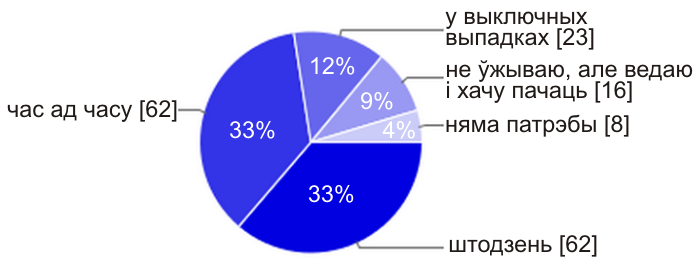
"How often do you use Belarusian language?" About 75% of the participants aged 18 to 35 years. About 66% used the Belarusian language on a daily basis or from time to time, indicating that the majority of respondents have interest in the development of the Belarusian language and the knowledge of it.
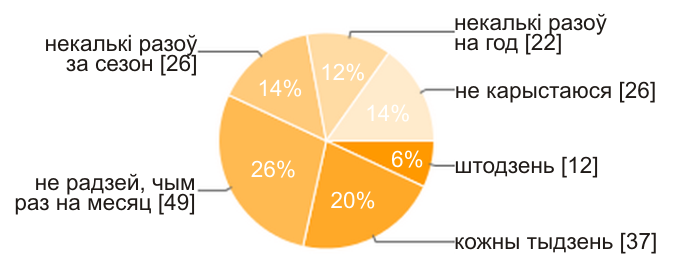
About half of the respondents (52%) in answer to the question "How often do you use Belarusian Wikipedia?" said they use it at least once a month: daily - 6% , weekly - 20%, once a month - 26%, do not use at all - 14%.
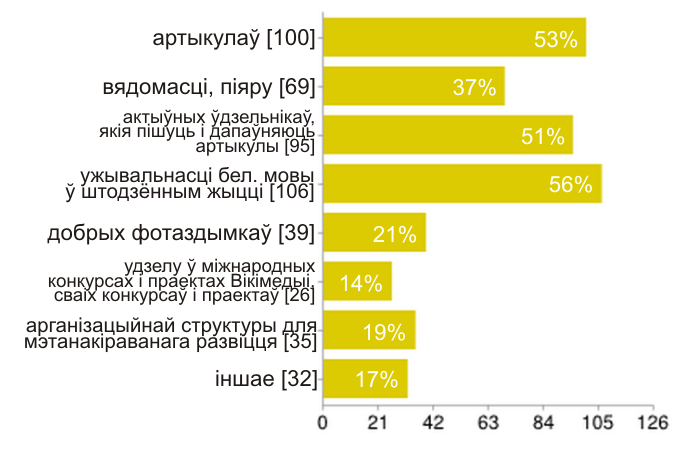
In the responses to the question "What are you missing in By.Wikipedia?" we found out that firstly they do not use Belarusian in everyday life (56%). Apart from this there were answers as following:
the lack of articles (53%) and active members (51%). One in five believes in the need for the development of organisational structure (19%), which is already presented in numerous language sections.
At the request "What kind of articles are missing?" the majority pointed not at the specific topics but at the subject areas, first of all at the scientific field as well as various sciences that are not presented in Belarusian Wikipedia. The other answers concerned the subject of the history and geography of Belarus and other countries, cultural phenomena, events, personalities, etc.
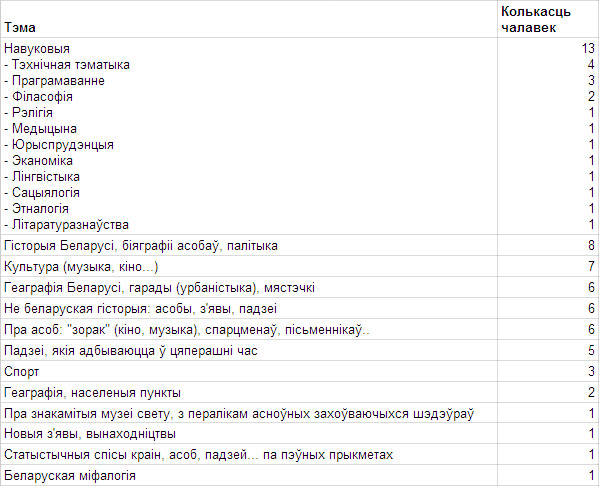
We got some specific requests for topics: Belarusian demonology (wolverine, vuzhalka, gaevki), the music band Dzidzio, musical instruments (acarina), the initiative "Food Not Bombs". There were more proposals, but some of them are already presented in Belarusian Wikipedias.
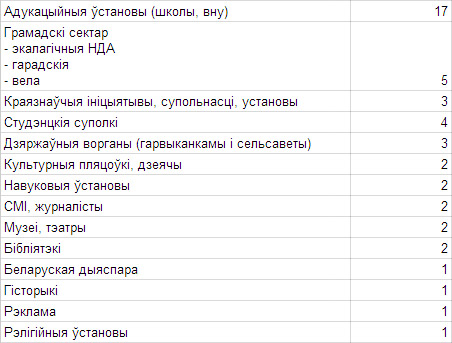
Similarly, the request for making a list of organisations and communities, which would be interested in using Wikipedia, caused some confusion. Most of the participants noted the range of public institutions and communities, among which there were educational institutions. The list included MovaNanova, Budzma belarusami, ArtBelarus, Dzedzich, LGBTQ+, The National Technical University Scientific Library, Lyrk, The Roman Catholic Archdiocese of Minsk-Mohilev, etc.
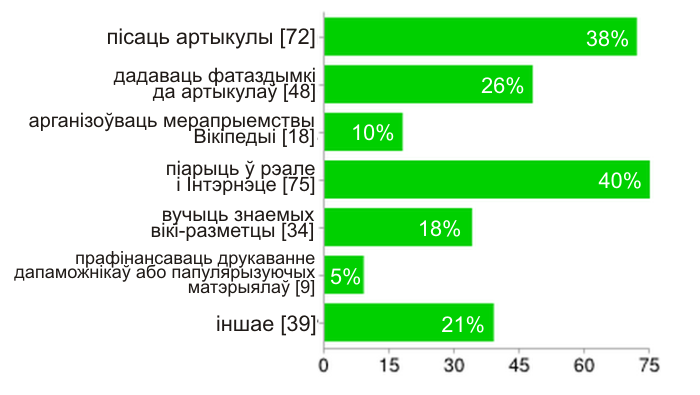
The question "In what way are you ready to participate in the development of the Belarusian Wikipedia?" found out that there are people willing to write articles, participate in Wikipedia PR companies, add photos, and organise events.
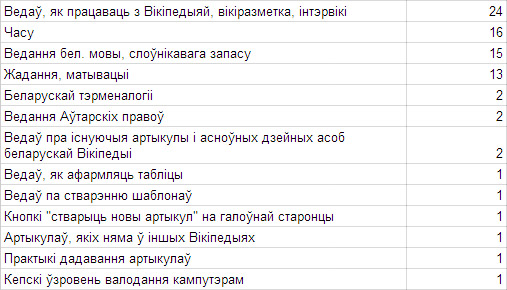
At the same time we asked to indicate what they lack in (knowledge, skills, etc.) and what prevents them from the active development of a Wiki-community. "The lack of time, desire or motivation" was the most common answers. Some admitted the lack of knowledge in "How to work with Wikipedia" and the low proficiency in the Belarusian language.
We asked to leave contacts for feedback. Every third respondent did it (61 respondents). Contacts will be used by Falanster in order to propose participation in Wiki-activities and spread the theme information.
Сonclusions:
- Many participants did not know how Wikipedia works. This applies not only to the Wiki markup language (and other technical components), but also to the background ideology of Wikipedia and its community. Such misunderstanding of technical and ideological context will lead to poor motivation and weak interest in active development.
- Tough usage or ignorance of the Belarusian language. Moreover, most of Belarusian people are afraid to speak or write in Belarusian, even if they know the language.
- Low motivation of potential participants to dedicate time and efforts to Wikipedia. This is the first challenge for the current active Wiki-editors. Who will continue the work?
- There is a serious lack of information about small, rare or local phenomenons, events, and people. The respondents highlighted the strong demand in articles and information, which are not similar to the "large chapters" (English or Russian).
Suggestions:
- Survey respondents expressed a strong need in real-life communication. Here the formula for bridging the gap in"ignorance" and "fear of technology" is very simple: it is necessary to establish Wiki-events and spread the information that Wikipedia is the result of people's work for themselves, which spreads knowledge freely and widens communication.
- Wikipedia is a community, in which people support each other, so in order to overcome the language barrier (shyness, insecurity and similar phobias) - let's start writing articles and asking questions. Cooperation and constant communication greatly contribute to usage of the language on daily basis.
- A motivation list should be prepared: how can Wikipedia help people and why is it worth dedicating time and knowledge to it or investing money? Real-life communications should be included in the list as well.
- People want to know their national parties, events, geographical features, so let's focus on various local social events (contests, theme months, sprints).
A detailed analysis can be found in Google docs (in Belarusian).
Falanster thanks all the communities and media that supported the promotion of WikiSurvey and offers further cooperation: adukacyja.info, The NDA Assembly, n-europre.eu, La Mora, 17-11.info, nn.by, Fialta, BSU, About Vitebsk, kli4nik.info, The Minsk Urban Platform, movananova.by, Fisher's House, Wikipedia in FB, t-styl.info.
If your community also has spread the information, but we haven't mentioned it - write to us and we will correct it.
Who did not take part in the survey may do it right now. We continue to contact people interested in any form of cooperation.